Wednesday, 1 February 2012

Deadly attack on Colombia police station kills seven


Devastation in a street in Tumaco, Colombia after a bomb attack on a police station

Related Stories

The Colombian Red Cross says at least seven people have been killed and 70 injured in an attack on a police station in the southern city of Tumaco.
A motorcycle laden with explosives was driven into the police station in the centre of the Pacific port city.
Police officials say Colombia's left-wing Farc rebel group was behind the attack.
The officials say they believe the rebels were targeting regional police commander Gen Jorge Nieto Rojas.
Gen Nieto Rojas was not hurt in the attack.
Tumaco is one of Colombia's most lawless cities, where drug trafficking gangs and leftist rebels fight for control of the lucrative Pacific coast drug smuggling routes.
In the deadliest rebel attack of 2011, Farc guerrillas ambushed and killed 10 soldiers near Tumaco in October.
And in July, more than a dozen prisoners escaped from the city's jail after Farc rebels blew a hole in the prison's perimeter wall.
The Marxist-inspired Farc has been active since the early 1960s.
It has been severely weakened by military offensives and the killing of two of its top leaders, but remains capable of carrying out attacks, in part due to cash raised through its involvement in the illegal drugs trade.

Sri Lanka Togo refugees condemn 'miserable conditions'


Sri Lanka Tamil refugees in Togo The refugees (whose faces have been covered to protect their identity) say that they face a grim future in Togo and Sri Lanka
About 200 Sri Lankan Tamil refugees have told the BBC that they are enduring miserable conditions in the West African state of Togo.
They say they are living on meagre rations and face the prospect of imminent deportation home, where their lives are in danger.
The refugees say they are being detained by the army in an open sports stadium in the capital Lome.
The Togo authorities have declined to comment on their claims.
The refugees say they fled Sri Lanka to escape government persecution.
Tamil Tiger rebels fighting for a separate homeland in the island were defeated in 2009 by the military after decades of fighting.
The Sri Lankan government insists that only Tamils guilty of war crimes have anything to fear by staying in the country.
But their assurances have not stopped hundreds trying to leave Sri Lanka - mostly travelling illegally by boat to Australia, Canada and Europe.
'Inhuman conditions' Those being held under tight security in Togo told the BBC by telephone that they were hoping to get to Canada by boat from Ghana after travelling through India and Ethiopia.
Ten used by a Sri Lanka Tamil refugee in Togo Many of the refugees say that they have been hit by malaria
But they say that they were tricked by their agent - who has now vanished.
He was supposed to have arranged their journeys, but instead "dumped" them in Togo after charging them $6,000 (£4,000) each.
"We have been arrested on charges of overstaying our visa period since 24 October and have been told that unless we voluntarily return to Sri Lanka, we will be deported forcefully," an inmate at the stadium detention centre told the Tamil Service.
Many of the refugees are from the northern and eastern areas of Sri Lanka where the final phase of the war took place - and if they are deported, their lives will be in jeopardy.
The detainees - who include 19 women and 11 children - say they have to endure bad weather and humiliating treatment by guards at the stadium.
They say they are facing deportation even though many are suffering from malaria and have not received any medical treatment.
"Every morning we are woken early and made to sweep the entire stadium and clean the toilets used by the military," another camp inmate said.
It is expected that the first group of 28 refugees could be made to return as early as 4 February.
Togo has been accused of human rights violations by campaigning groups for many decades.

Australia bus boss gives staff $16m sale share


Ken Grenda: "Look after your staff and they'll look after you"
Australian Ken Grenda may have sold his bus company, but his staff of almost 2,000 are smiling.
Mr Grenda gave cash bonuses totalling A$15m ($16m, £10m) from proceeds of the sale to employees of his 66-year-old Melbourne-based company.
The bonuses, averaging A$8,500, were based on the length of service. Some workers received A$30,000 to A$100,000 each, Australian media reported.
The company was sold to Ventura, another transport company, for A$400m.
"You know we've got employees that stretch over 40 years, so it is a pretty nice thing to do," Mr Grenda's son, Scott, told ABC News.
Mr Grenda, who is also the managing director of the company, said his father was sad about selling the business and wanted to show his gratitude to the staff for their service.
"A business is only as good as its people and our people are fantastic," said the senior Mr Grenda, who has been dubbed the ''best'' and ''most generous'' boss in Australia.
"We have had people here who are second generation, and one fellow in the same job for 52 years.''
The employees were surprised and overwhelmed by the gesture, Australian media reported, with some even calling their banks to ask if there had been a mistake in their statements.
The Herald Sun newspaper reported that all the staff would keep their jobs under the new management.
One bus driver identified only as John told ABC radio that Mr Grenda was ''a generous person and a true gentleman''.

Europe freeze: Heavy snow across continent


Scenes of snow and cold weather around Europe

Related Stories

Heavy snow has caused disruption across Europe, carpeting much of Italy to the south and Turkey to the east.
The freeze that has swept south through the continent has caused at least 80 deaths, mainly in Ukraine and Poland.
Temperatures were so low that some areas in Romania along the shores of the Black Sea froze.
In central Italy, heavy goods lorries were barred from motorways and several top-flight football matches have fallen victim to the wintry conditions.
Ukrainian officials reported that the number of deaths attributed to the freeze had risen to 43, with 13 people falling victim to hypothermia in the past 24 hours.
Schools and colleges in the capital, Kiev, were shut on Wednesday because of the severe cold.
School closures were also reported in northern Greece, where temperatures of -16C (3F) were recorded.
Bosnians waiting for supplies in Sokolac (1 Feb 2012) Villages were cut off in Bosnia where temperatures fell to -10C
Several towns and cities in Bulgaria saw record lows, with -29C reported in Kneja in the north for the second day running. For much of the country an "orange" alert was in place, warning of dangerously low temperatures.
A 57-year-old man froze to death in a village in the north-west and 450 schools were closed across the country.
In Bosnia and Serbia helicopters were used to airlift supplies to villages cut off by drifting snow.
Seven more deaths were reported in Poland, bringing to more than 20 the number who have fallen victim to the cold snap. Five were said to have been homeless people.
German media reported that ice and sub-zero temperatures had led to the deaths of two women: a pedestrian froze after falling into a drainage ditch and a driver was killed when she lost control of her car on an icy road.
Workers clear snow at the Renato Dall"Ara stadium in Bologna (1 Feb 2012) For a second night running, matches in Italy's Serie A were called off
In Turkey, three crew-members from a ship that sank during a storm in the Black Sea were pulled out alive by coastguard near the north-western port of Eregli but eight others were missing.
The bulk carrier Vera, with a crew of 10 Ukrainians and a Georgian, had been carrying a cargo of scrap metal from Rostov in Russia to Izmir in western Turkey.
Snowfalls were recorded as far south as southern Italy and Corsica, where at least 20cm of snow covered the centre of the Mediterranean island.
Italian rail services were reduced because of the wintry conditions. In Sicily, a one-year-old boy was fatally injured when his mother's car went into a stream swollen by torrential rain.
Several football matches in Italy's Serie A were postponed on Tuesday night and there were doubts that Wednesday's clash between Inter Milan and Palermo would take place. Workers cleared snow from the pitch at the Renato Dall'Ara stadium in Bologna but the match against Fiorentina was later postponed.
The cold snap, according to forecasters, is due to an area of high pressure that has extended across Europe from Siberia and is expected to reach its peak at the weekend.
BBC weather presenter Peter Gibbs said he expected the bitter weather to continue for several more days across most of Europe, with cold winds and snow also spreading further south to affect the Balearic Islands and parts of northwest Africa by the weekend.
More details from BBC Weather BBC Weather

Lesbian killers in South Africa get 18-year jail terms


People hold up a poster of Zoliswa Nkonyana at a court hearing in September 2011 Copyright: Malungelo Booi/EWN The four men were convicted of Zoliswa Nkonyana's killing in October last year

Related Stories

Four South African men have been sentenced to 18 years in jail for stabbing and stoning to death 19-year-old lesbian Zoliswa Nkonyana in 2006.
The court found that the men killed Ms Nkonyana because she was living openly as a lesbian.
A crowd outside the court in Khayelitsha, a Cape Town township, cheered and danced at the sentencing.
The constitution protects people on the grounds of sexual orientation - but homophobia is widespread.
The BBC's Pumza Fihlani in Johannesburg says the sentence handed out in the Nkonyana case is highly significant - both because of its length and the fact that the magistrate concluded that Ms Nkonyana was killed for being a lesbian.
For years activists have been calling on the state to be tougher on people who kill or attack people because of their sexual orientation - and they want the state to recognise hate crimes against lesbians, she says.
'Sets a precedent'

Analysis

Gay right groups see this ruling as a milestone because this is the first time a court has said the sentence was influenced by the fact that the victim was killed because she was a lesbian. They have been campaigning for the state to recognise crimes against lesbians as hate crimes - and pass harsher sentences.
More than 30 lesbians have been killed in the past 10 years because of their sexuality and the so-called practice of "corrective rape" also appears to be on the increase, according to gay activists.
South Africa recently set up a team to tackle hate crimes against gay people. Activists hope this dedicated team will help to increase the number of convictions for homophobic crimes.
In traditional African society, homosexuality is not accepted - especially among women and some have pointed to this as the reason for the attacks. Black lesbians say that they live in constant fear.
Lubabalo Ntlabathi, Sicelo Mase, Luyanda Londzi and Mbulelo Damba - who were convicted in October - were each given 18 years.
Five other people were acquitted.
The family of Ms Nkonyana welcomed the sentence.
"They did not accept responsibility for what they did and we are happy that when we asked for a lengthy jail term, the magistrate agreed to that," stepfather Mr Mandini told South Africa's Sowetan newspaper.
Ms Nkonyana was stoned and stabbed nine times in February 2006, just metres from her home in Khayelitsha.
The magistrate said it was clear the motive for the killing was hatred and homophobia - and Wednesday's sentence was meant to send out a signal that violence based on sexual orientation will not be tolerated, the South African Press Association reports.
Jill Henderson from the Triangle Project - a non-governmental organisation that fights for the rights of gay and lesbian people in Khayelitsha - said this was a good move.
"The magistrate has named hate and intolerance on the basis of sexual hate and intolerance on the basis of sexual orientation as an aggravating factor in sentencing - that is the first time that has happened in a criminal trial in South Africa. It has therefore set a precedent," she told the BBC's Focus on Africa programme.
'Corrective rape' In December, the global rights group Human Rights Watch said in a report that South Africa is "desperately failing lesbian and transgender people" - despite the country's liberal laws.
South Africa is the only African country where same-sex marriage is allowed.
But violence against gay and lesbian people is common, particularly in black communities, our correspondent says.
Lesbians are often subjected to "corrective rape" by men who think this will "cure" them of their homosexuality.
Three years ago, a man was sentenced to life in prison and another to 32 years for the gang rape, robbery and murder of Eudy Simelane, a lesbian activist who had been a midfielder on the national football team.
Last year, a man was sentenced to 15 years in prison for the rape and murder of Nqobile Khumalo, a lesbian in Durban.

Plastic wedding rings used in Nottingham sham marriages


Picture of Phillips Onikoyi Phillips Onikoyi made thousands of pounds out of the fake marriages scam

Related Stories

Couples involved in fake marriages in Nottingham did not speak the same language and wore plastic wedding rings.
On one occasion Phillips Onikoyi, who has been jailed for organising at least 16 sham marriages over two years, took pictures of two people in Nottingham's Old Market Square to make them look like a happy couple.
He also provided "one size fits all" clothing to wear during the weddings.
The scam allowed Nigerians to stay in the UK because they had married a European with residence rights.
Onikoyi found Nigerians fake marriage partners who were entitled to live in the UK.
Organised crime They were all Dutch nationals and many originally came from the Dutch Antilles in the Caribbean.
Andy Ratcliffe, from the UK Border Agency, said: "They were flying over for 24 hours, basically overnight, and then going back to Holland.
"After the wedding they would never come back to the UK."
Onikoyi introduced the couples to the vicar and was usually present when the marriages took place.
The Nigerians then applied for leave to remain in the UK.
Rings Plastic wedding rings were used during the sham marriages
Twenty suspected marriages took place at St Aidens Church in Basford, Nottingham.
Sam Bullimore, from the UK Border Agency, said: "[The marriage register] absolutely takes off in 2009.
"There's a huge amount of marriages involving Nigerians marrying Dutch nationals."
Someone else would assume the identity of the Dutch national for the purpose of living and working in the UK.
More often than not they were the genuine partner of the Nigerian, which meant that two identities were falsely used.
'Mr Big' Judge Robert Brown told Onikoyi at Leicester Crown Court he had "shown complete contempt for UK immigration law".
She added: "A message needs to go out that behaviour like this will not be tolerated.
"Your case has the aggravating feature that you systematically made trips to Holland to bring people back for sham marriages."
Onikoyi, formerly of Stanley Road, Hyson Green, Nottingham, is a Nigerian national who came to Britain in 2008 on a student visa.
He married a British national and was allowed indefinite leave to remain in the country.
Mr Bullimore said: "This is an organised crime group and Mr Big lives in Nottingham. We're very pleased to have convicted him."

Serial locker thief banned from leisure centre and gyms

A thief described by the police as the "scourge of West Midlands gym-goers" has been banned by a court from every leisure centre and health club in the West Midlands.

Lee Lynch, 48, from Kingshurst, Solihull, was jailed for 56 weeks when he appeared at Birmingham Crown Court.
He admitted breaking into lockers and stealing wallets, cash and mobile phones.
Police said the order was essential to "curb Lynch's offending pattern".
PC Paul Dempsey, of Solihull Police, said: "He has been the scourge of gym-goers and has been convicted of 143 offences in and around the West Midlands area."
The four year Criminal Anti-Social Behaviour Order also restricts him from the grounds and buildings of any school, university or college campus in the West Midlands without the prior approval of the police.
Lynch was given a 32-week jail sentence suspended for two years by magistrates in 2011.
That suspended tariff was triggered by his most recent thefts and counted towards his 56-week sentence.

Bristol girl's terror after pregnant mum hit


The girl's letter to the judge The girl spoke, in her letter, about how she was "terrified" by the incident
A five-year-old girl's letter to a judge describing her terror when two teenage muggers attacked her pregnant mother has been released by police.
Thaberi Francis, 18, was jailed for the attack on the pregnant woman. Nathaniel Moffett, 16, was jailed for other robberies carried out with Francis.
The letter from the girl, who cannot be named for legal reasons, spoke of how her mother was hit.
"The boy punched my mum and hit the baby in her tummy," said the girl.
"I was terrified wot happened at Morrisons. The other boy made sure nobody was looking. Now I don't like going shopping," she told Judge Simon Darwall-Smith in a letter to the court.
"I hope they don't hurt anymore people. Thank you."
Nathaniel Moffett and Thaberi Francis Moffett and Francis were jailed at Bristol Crown Court
Moffett, of Cherry Tree Road, Fishponds, and Francis, of Stonebridge Park, Eastville, were jailed for five and six years respectively on Tuesday for the attack on the mother and other offences in Bristol.
They were jailed at Bristol Crown Court for robbery, attempted robbery and possession of bladed articles.
Det Con Paul Hopes, from Avon and Somerset Police, said it was only by "chance" nobody was seriously hurt.
"It is this girl who has actually written her own letter to the judge to say how she feels about what happened," he said.
"A street robbery is a traumatic, highly impactive crime for most victims. In this case this was made even worse by the use of weapons, in particular knives.
"Some victims, such as elderly people, never recover from the mental anguish or physical injury caused by these crimes.
"I can only hope that the sentence passed brings some comfort to their victims."

Fatal shooting near Turnpike Lane Tube station


A man has been shot dead near a north London Tube station.
Scotland Yard said it was called to reports of a shooting in Langham Parade, near Turnpike Lane Tube station at about 15:30 GMT.
An air ambulance arrived shortly afterwards and a man thought to be in his mid-30s was pronounced dead at the scene, Scotland Yard said.
Scotland Yard appealed for witnesses to come forward and said the victim had not been formally identified.
Turnpike Lane Tube station, which is on the Piccadilly line, is still open, but one exit has been closed, Transport for London said.
Langham Road was cordoned off by police while a number of officers, including forensics officers, remained at the scene on Wednesday evening.
It is the second fatal shooting in the capital this year, the Metropolitan Police confirmed.

British men forced into 'modern slavery' abroad


One victim talks about his experience as a 'slave' in England and Sweden

Related Stories

Criminal elements of the British and Irish travelling community have been transporting vulnerable British men abroad to work as virtual slaves.
An investigation by the BBC Ten O'Clock News and Radio 5 Live Breakfast has uncovered at least 32 victims.
The European Commission describes it as modern slavery and says this is the tip of the iceberg.
There have been confirmed cases in six European countries, including Sweden, Norway and Belgium.
The gangs pick vulnerable men off the streets in the UK, who are often homeless and many have drink or drugs problems.
They are promised well-paid work, but are then transported abroad where they are forced into long, hard days tarmacking or paving driveways for little or no money.
One man the BBC spoke to had arrived in the Swedish port of Malmo with two other Britons who all had been homeless when they were picked up. He has asked not to be named, because he fears for his safety.
The men worked 14-hour days for little or no pay and lived in appalling, cramped conditions. They were too frightened to escape, until the Swedish police offered them help. He says there was a culture of violence.
"I've seen people threatened with pickaxes. I've seen people kicked, punched. I've nearly been pushed off a moving vehicle. It's very tense. You're waiting for the next thing to happen, " he says.
'Targeting most vulnerable' The European Commissioner for Home Affairs, Cecilia Malmstrom, says she fears this is only the tip of the iceberg.

Start Quote

That physically fit British men can be threatened or coerced into working without pay and living in fear for their safety reflects the brutal reality of modern slavery”
Aidan McQuade Anti-Slavery International
"It's a horrible crime and it's modern slavery," she says.
"They are using very vulnerable people and especially in hard economic times, people have lost work, nowhere to live, thrown out from families. We must act much stronger than we have done. It's only recently we have been aware of the amount of the problem."
The project manager of human trafficking at the European law enforcement agency, Europol, believes there have been dozens of British victims. David Ellero says traveller gangs have been doing this for a long time.
"[They are] targeting the most vulnerable in society and forcing them to work, but the cases are not categorised as trafficking. The work is normally carried out in northern Europe, where they work in rural areas and focus on elderly victims.
"These people are intimidated into paying for substantial work, so it is a double crime, exploitation of the victims and fraud of the person paying."
A report into human trafficking in Sweden, published in 2010, found 26 reports of human trafficking for non-sexual purposes. "In particular, these concern British and Irish tarmac and paving layers in Sweden," it says.
"The victims do not usually report personally that they have been the subject of human trafficking because they often have no confidence in the authorities that administer justice and are afraid of acts of reprisal."

'It cost him his life'

Oliver Hayre, 22, from Lincolnshire, died in a caravan fire in Sweden in 2005 after working in appalling conditions for a traveller gang for more than three months.
The British inquest into his death heard how Oliver had been afraid of his bosses.
A police report prepared for the coroner said several of his friends had claimed that his savings and passport had been confiscated, and that Oliver had been beaten up over trivial matters and was only staying to keep his parents safe.
Detective Superintendent Guy Collings, who investigated his death, said: "It is my view that Oliver was most definitely the victim of trafficking by a gang of individuals who in effect kept him hostage by removing his passport and threatening violence if he did not comply."
He said Oliver was taken to hospital after an assault: "The gangs create a culture of fear, and Oliver and others like him are placed in fear for their own safety and that of their families back home."
Oliver's parents want the government to do more to stop such exploitation.
His father, Martin Hayre, said: "It's the 21st Century, we abolished slavery, but yet we haven't... my perception of the authorities is that they turn a blind eye to it and the intimidation to Oliver was real. It cost him his life."
Another confidential Swedish police report, obtained by the BBC, underlines just how lucrative the business is for the gangs. Their "conservative calculation" suggests criminal gangs are making about £3m in a year from what the report calls "black labour".
In 2007, Norwegian police estimated traveller gangs operating there made more than £11m in a year. The problem of vulnerable people being used for forced labour has become so serious in Norway that the police have been given new instructions on how to deal with it.
In Belgium, the ministry of justice has said it is currently investigating a case involving British nationals being trafficked into the country for forced labour.
The BBC has also heard anecdotal accounts from soup kitchens, shelters, church groups, homeless charities, anti-trafficking organisations and trade unions which suggest that traveller gangs are also operating in Germany, Holland and Denmark.
Dr Aidan McQuade, director of Anti-Slavery International, says the BBC's investigation shows how vulnerable, often homeless, people were being targeted for forced labour.
"That physically fit British men can be threatened or coerced into working without pay and living in fear for their safety reflects the brutal reality of modern slavery," he says.
"The widespread nature of the problem means that it is essential that local police officers consider new approaches to investigating this crime, such as regular meetings with homeless charities, soup kitchens and migrant drop-in centres to identify risks and potential victims of trafficking, and gather intelligence on gangs seeking to exploit vulnerable people for forced labour."
He believes that the British and other governments should be doing much more to combat the problem. That is certainly on Commissioner Malmstrom's agenda. "This is not worthy of Europe today," she says, "and we should do everything to prevent it."
A Home Office spokesman said: "The government is committed to tackling human trafficking and preventing the harm it causes to vulnerable members of our society.
"The National Crime Agency on establishment in 2013 will have a key role in building on the existing arrangements for tackling human trafficking. Its enhanced intelligence capabilities and co-ordination functions will target the organised criminal gangs involved in human trafficking, wherever they are."
Yvonne MacNamara, director of the Irish Traveller Movement in Britain, said her organisation condemned "absolutely slavery and forced labour, not least because travelling people have been subjected to slavery and forced labour throughout their history, including recent history.
"If individuals are suspected of criminality, they should be subjected to the full force of due process and the law."

Egypt football violence leaves many dead in Port Said


BBC's Jon Leyne: "There has been plenty of violence at Egyptian football games before"
At least 74 people have been killed in clashes between rival fans following a football match in the Egyptian city of Port Said.
Scores were injured as fans - reportedly armed with knives - invaded the pitch after a match between top-tier clubs al-Masry and al-Ahly.
Officials fear the death toll could rise further.
It is the biggest disaster in the country's football history, said the Egyptian deputy health minister.
"This is unfortunate and deeply saddening," Hesham Sheiha told state television.

Analysis

Football fans in Egypt can be violent, and certainly there is a bitter rivalry between these two teams.
The al-Ahly fans, known as Ultras, have a particular reputation for violence.
But lately they have been at the forefront of clashes with the police.
On the social media, there has been speculation - and I hasten to add there is no evidence - that the security forces may have had an interest in taking on al-Ahly supporters.
Certainly riot police did not seem to be very effective, they were standing around, but maybe there simply were not enough there.
Some of the dead were security officers, the Associated Press news agency quoted a morgue official as saying.
The BBC's Jon Leyne in Cairo says it appears some fans had taken knives into the stadium.
Our correspondent says the lack of the usual level of security in the stadium might have contributed to the clashes.
Police in Egypt have been keeping a much lower profile since last year's popular protests that ousted President Hosni Mubarak from power.
Egyptian fans are notoriously violent, says our correspondent, particularly supporters of al-Ahly known as the Ultras.
They have been heavily implicated in confronting the police during recent political protests, our correspondent adds. There is speculation that the security forces may have had an interest in taking on al-Ahly supporters.
'Black day' Wednesday's violence broke out at the end of the match, which, unusually, Port Said side al-Masry won 3-1.

Major football stadium disasters

  • May 1964: 318 people killed in riots during a Peru-Argentina match at the National Stadium in Lima
  • June 68: More than 70 people die in a gate stampede after a River Plate-Boca Juniors match in Buenos Aires
  • Jan 71: 66 people killed in a crush after a Rangers-Celtic derby in Glasgow, Scotland
  • Feb 74: 49 people trampled to death at a match in Cairo
  • Oct 82: More than 300 reportedly killed in a stampede on a narrow, icy staircase at a Spartak-Haarlem match in Moscow
  • May 85: 56 people die in a terrace fire during a Bradford City-Lincoln City match in Bradford, England
  • May 85: 39 people are killed when a separation wall collapses at a Liverpool-Juventus European Champions Cup final at Heysel Stadium in Brussels
  • March 88: 93 people die in a stampede after fleeing a hailstorm at the national stadium in Kathmandu, Nepal
  • Apr 89: 96 people are crushed to death at a Liverpool-Nottingham Forest cup match in Sheffield
  • Jan 91: At least 40 people die in a stampede after riots at a friendly match in Orkney, South Africa
  • Oct 96: About 80 people are killed in a stampede before a Guatemala-Costa Rica World Cup qualifying match in Guatemala City
  • Apr 01: More than 40 people killed in a crush at the overcrowded Ellis Park stadium in Johannesburg, South Africa
Witnesses said the atmosphere had been tense throughout the match - since an al-Ahly fan raised a banner insulting supporters of the home team.
As the match ended, their fans flooded onto the pitch attacking Ahly players and fans.
A small group of riot police tried to protect the players, but were overwhelmed.
Part of the stadium was set on fire.
Officials say most of the deaths were caused by concussions, deep cuts to the heads and suffocation from the stampede.
"This is not football. This is a war and people are dying in front of us," al-Ahly player Mohamed Abo Treika said.
Hani Seddik, who played for al-Ahly as a teenager, told the BBC: "I don't think this is about football. These trouble-makers were not football fans."
"How were they allowed to carry knives into the ground? To me, this is the actions of people who do not want the country to be stable and want to put off tourists from coming here," said Mr Seddik, who was watching the match on TV in Cairo.
Meanwhile, the Muslim Brotherhood - which has emerged as Egypt's biggest party in recent elections - blamed supporters of ousted President Hosni Mubarak for the violence.
"The events in Port Said are planned and are a message from the remnants of the former regime," Muslim Brotherhood lawmaker Essam al-Erian said.
He went on by saying that the army and police wanted to silence critics demanding an end to state of emergency in the country.
In Cairo, another match was halted by the referee after news of the Port Said violence. It prompted fans to set parts of the stadium on fire.
Egyptian journalist Ashraf Khalil: "Where was the security"
All premier-league matches have been cancelled and the newly-elected Egyptian parliament is to hold an emergency session on Thursday.
Fifa President Sepp Blatter later issued a statement, expressing his shock over the incident.
"This is a black day for football. Such a catastrophic situation is unimaginable and should not happen," he said.

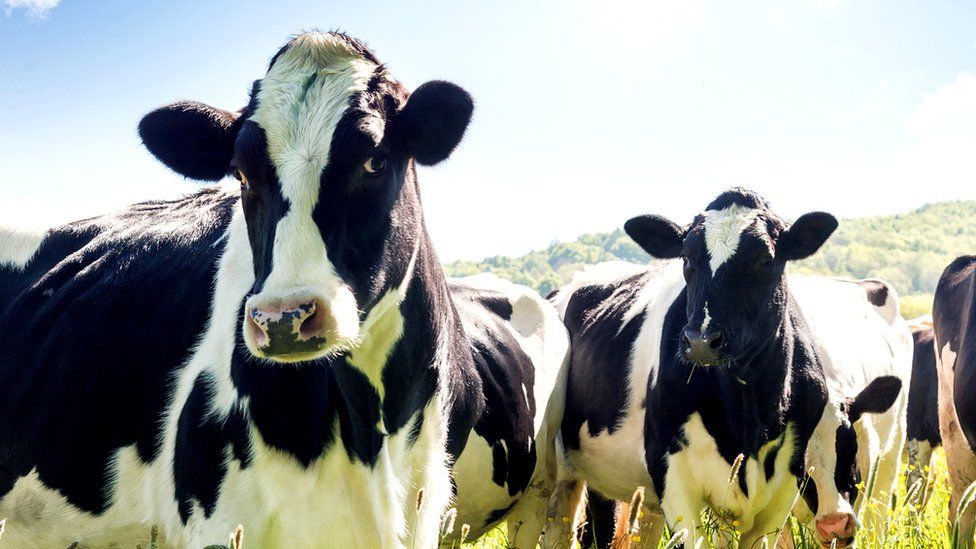
Why cows may be hiding something but AI can spot it

  By Chris Baraniuk Technology of Business reporter Published 22 hours ago Share IMAGE SOURCE, GETTY IMAGES Image caption, Herd animals like...