Monday, 30 January 2012

Syria's Assad will go, says US, as UN vote nears


Activists say 95 people were killed across Syria on Monday
The US has called on countries to decide where they stand on what it calls the Syrian regime's brutality.
Activists say 95 people were killed across Syria on Monday in cities including Damascus and Homs.
The White House said President Bashar al-Assad had lost control of Syria, adding "he will go".
Russia has said it will block a UN resolution calling for Mr Assad to hand power to a deputy who would then form a government of national unity.
Moscow said the text - proposed by the Arab League and backed by the US, the UK and France - was "not balanced" and would "leave open the possibility of intervention" in Syria's affairs.
White House spokesman Jay Carney: "Assad's fall is inevitable... The regime has lost control of the country"
The Local Co-ordination Committees, a network of anti-government groups, said on its Facebook page Monday's death toll was 95, including 72 in the central city of Homs. In Deraa, in the south, 15 people were killed, while six deaths were reported in the Damascus suburbs.
Their claims cannot be independently verified, as the the BBC and other international media are severely restricted inside Syria.
However, heavy machine-gun fire was reported in the restive Bab Amr district of Homs, while activists said at least 225 tank shells were fired at the eastern suburbs of Damascus.
Earlier, reports said the Syrian army had regained control of some Damascus suburbs recently held by rebel forces.
Qatari backing
The White House said countries weighing their options at the Security Council should take into account that Mr Assad would be ousted.

Analysis

Western states hope Tuesday's Arab League briefing to the Security Council can break the impasse over Syria. US and European foreign ministers will be present to demonstrate their support for the Arab plan, which they want the council to endorse.
But the Russians have met this combined offensive with rejection. Keen to protect a thriving arms trade with Syria, they have complained about the resolution's call to stop the flow of weapons to the country (although it doesn't impose an arms embargo).
But the critical issue is the fate of Bashar al-Assad, Russia's closest Arab ally. The Arab peace plan calls on him to delegate power to a deputy. For the Russians, this is regime change by another name.
So the bottom line is: can there be a compromise between Arab and Western states on the one hand, which says there there is no solution with Assad, and Russia on the other, which insists there is no solution without him.
"The regime has lost control of the country and will eventually fall," said spokesman Jay Carney.
Moscow, which has maintained its ties with Damascus, has so far resisted moves for a UN resolution condemning the violence in Syria. Russia has a naval base in the country and supplies arms to Syria.
"The current Western draft... certainly cannot be supported by us," Deputy Foreign Minister Gennady Gatilov told the Interfax news agency.
Mr Gatilov said the draft was "not balanced" and "leaves open the possibility of intervention in Syrian affairs".
France says 10 of the 15 countries on the Security Council now support the Arab League text. A minimum of nine council members must lend their backing in order for a resolution to be put to a vote.
However, Russia - as one of the five permanent council members - can veto any proposed resolution.
The BBC's Barbara Plett, at the UN, says Russia views the resolution as a first step towards regime change.
The UK has urged Moscow to reconsider its opposition.
"Russia can no longer explain blocking the UN and providing cover for the regime's brutal repression," said a spokeswoman for Prime Minister David Cameron.
On Monday, Russia also offered to mediate talks between the Syrian government and the opposition - a suggestion the opposition rejected out of hand.
The Syrian government has rejected the Arab League plan, which would see Mr Assad's deputy forming a national unity government within two months.
The prime minister of Qatar and the secretary-general of the Arab League are also going to New York to seek support for the draft text.
Qatar heads the League's committee dealing with the Syrian crisis and has previously called for Arab countries to send troops into Syria.
On Saturday, the Arab League announced it was suspending its month-old monitoring mission in Syria because of an upsurge of violence.
The Syrian army held funerals on Monday for 22 of its members killed in the previous 24 hours. The BBC's Jim Muir, in neighbouring Lebanon, says on average 20 members of the security forces are being killed each day.
Reports have emerged suggesting security forces may have killed senior army defector Lt-Col Hussein Harmoush, one of the first military officers to publicly declare his opposition to Mr Assad last year.
However, the Free Syrian Army, many of whose members are based in Turkey, said they could not confirm reports of his death.
Damascus and suburbs

Why do some people never get depressed?


Smiling face, and brain activity it triggers
Confronted with some of life's upsetting experiences - marriage breakdown, unemployment, bereavement, failure of any kind - many people become depressed. But others don't. Why is this?
A person who goes through experiences like that and does not get depressed has a measure of what in the psychiatric trade is known as "resilience".
According to Manchester University psychologist Dr Rebecca Elliott, we are all situated somewhere on a slidling scale.
"At one end you have people who are very vulnerable. In the face of quite low stress, or none at all, they'll develop a mental health problem," she says.
"At the other end, you have people who life has dealt a quite appalling hand with all sorts of stressful experiences, and yet they remain positive and optimistic." Most of us, she thinks, are somewhere in the middle.

A measure of resilience

Aeron Haworth
Aeron, a subject in the Manchester study:
I used to have a business that we ended up having to close. I lost my employment, my income, and my home.
I'm generally a happy person. Everybody has stressful moments but there would be something wrong with you if you were happy all the time. But I haven't ever had an episode of depression.
In my childhood, when I first realised I was gay, I didn't come out to my parents or friends, not until I was much older. I think, perhaps, it resulted in me building up a strong defence mechanism and helped me deal with situations better later on in life.
I think that if there's a problem there's always a remedy. It's not that I don't think about stressful issues in my life, but I always think you can find a solution.
But what is this resilience? Is it something we inherit or do we learn it? Can it be traced in the chemistry of the brain? Or in its wiring, or its electrical activity? And if we lack it, can we acquire it?
The answer, regrettably, to all those questions is much the same. We don't really know. But we'd like to, and we need to. According to the World Health Organization, depression affects just over 120 million people worldwide.
"We think about a fifth of the UK population will suffer from depression at some point in their lifetime," says Bill Deakin, professor of psychiatry at Manchester University. Worryingly, he adds that more people are getting depressed now than in the past, and that it is beginning to affect younger people.
With the support of the Medical Research Council, Bill Deakin, Rebecca Elliott and their colleagues are peering into the brain, trying to fathom the origins and nature of resilience. They think that a better understanding of it might pay dividends in helping those who lack it.
The subjects of their study are a mixed bunch - intentionally so. Some have suffered bouts of depression, others have not. Some have had more than their share of adverse life events, while others have had an easier time of it.
In knowing where to start looking for the differences that might underpin resilience to depression the Manchester group has the advantage of being able to draw on previous work that has investigated resilience to post-traumatic stress disorder.
This, says Bill Deakin, has pointed them to several relevant features of brain function. They include cognitive flexibility - our capacity to adapt our thinking to different situations - and also the extent to which our brains concentrate on processing and remembering happy, as opposed to sad, information.
Emotional memory
Each subject in the Manchester study has been allocated to one of four groups based on the four possible combinations of high and low life stress, with or without depression. All have given saliva samples from which their stress hormone levels can be measured, and many of them will undergo a brain scan.

Depression - the global picture

  • Depression affects about 121 million people worldwide
  • Among the leading causes of disability worldwide
  • Fewer than 25% of those affected have access to effective treatments
  • 2011 survey found 15% of the population from high-income countries were likely to get depression over their lifetime - in low and middle-income countries the rate was 11%
  • Women twice as likely to suffer depression as men
Source: WHO World Mental Health Survey Initiative
A scanning technique much used by brain researchers called functional magnetic resonance imaging allows them to see which parts of the brain are active while subjects are performing specific tasks.
"In one task we give them pictures to look at which are emotionally charged," says Rebecca Elliot. "They have to memorise them." Shortly afterward they're shown these pictures again, with others, and have to identify those they've seen already. "This probes emotional memory - how well people remember material which has an emotional component to it."
The research is not yet complete, so Rebecca Elliott can't say whether there are distinct differences in brain function between the groups. But there are encouraging hints, such as the correlations she's finding between the psychological measurements of her subjects' resilience and how they perform on some of the tests.
"For example, our early data suggest that people who are more resilient are more likely to recognise happy faces and less likely to recognise sad or fearful faces. The more resilient someone is, the better they remember positive words and pictures."
Precisely how a clinician might eventually use whatever the Manchester research reveals about our brain activity is still an open question. What we refer to as resilience is the outcome of a complex and continuing set of interactions between our genes, our body chemistry, the wiring of our brains, and our life experiences.
But broadly speaking, the hope is that an understanding of the brain activity that underpins resilience might offer pointers towards new treatments, or better ways of using existing ones.
A resilience pill?
Bill Deakin talks of using brain scanning to create what he calls a "neuroscientific profile" of an individual's problem. This might be used to identify relevant aims and goals in deciding on the best treatment.

Find out more

  • Geoff Watts' two part programme on depression is broadcast on the BBC World Service programme Discovery
A patient may turn out to have normally functioning cognitive flexibility but a tendency to dwell on sad thoughts. "This might allow you to tailor-make a therapy to reduce the likelihood of a further episode of depression," says Deakin. In the first instance this would most likely be a talking therapy of some kind.
Responding to the suggestion that a drug, a daily "resilience pill", tailored to our brain activity or chemistry might be a useful development, Rebecca Elliott is cautious. "I suppose this is something that would theoretically be possible," she says. "Whether people would be willing to take that kind of drug, I'm not sure."
But whatever the means, finding some way to boost resilience is an ambition well worth pursuing. To be assured of that you have only to compare Aeron's experiences with those of Pauline, another of the Manchester research subjects.
While out of work, struggling financially, and single-handedly responsible for three children, Pauline had several bouts of depression during which she felt completely isolated. "And emotionally I was very detached. I would come in and sit on my bed and cry. And when it got so bad I didn't want to be with the children, that's when I went to the doctor."
No clinician can yet prescribe what she most needs - resilience. But one day… maybe.

EU summit: UK and Czechs refuse to join fiscal compact


Germany's Chancellor Angela Merkel says EU leaders have taken an "important step forward"
Twenty-five of the EU's 27 member states have agreed to join a fiscal treaty to enforce budget discipline.
The Czech Republic and the UK refused to sign up. UK Prime Minister David Cameron said his government would act if the treaty threatened UK interests.
He still has "legal concerns" about the use of EU institutions in enforcing the fiscal treaty, he said.
The Czechs cited "constitutional reasons" for their refusal, France's President Nicolas Sarkozy said.
Czech President Vaclav Klaus, a Eurosceptic, may be reluctant to sign the treaty, analysts say.
The goal is much closer co-ordination of budget policy across the EU to prevent excessive debts accumulating.
Germany - the eurozone's biggest lender and most powerful economy - was particularly keen to get a binding treaty adopted to enforce budget rules.
The treaty will empower the European Court of Justice to monitor compliance and impose fines on rule-breakers.
The treaty also spells out the enhanced role of the European Commission in scrutinising national budgets.
British PM David Cameron: "We will not be ratifying this treaty and it places no obligation on the UK"
The Czech Republic is not yet in the euro, but like the other new EU member states it is committed to joining.
European Union leaders also discussed ways to stimulate economic growth despite the stringent austerity budgets in many countries - and focused on how to reduce unemployment across the eurozone.
UK concerns
The UK and Denmark are the only states with explicit opt-outs from the euro.
Mr Cameron said "it's good that the new treaty is absolutely explicit and clear that it cannot encroach on the competences of the EU".Q&A: EU summit deal on debt crisisQ&A: EU summit deal on debt crisisQ&A: EU summit deal on debt crisis

Analysis

No-one believes that this treaty on its own will solve anything, and it could face an uncertain future. The Socialist candidate in the French presidential election Francois Hollande has promised to renegotiate it if he wins, and President Nicolas Sarkozy has now confirmed that the treaty will not be ratified in France before the election takes place.
In fact given general agreement on the need for measures to promote growth, some critics have described the fiscal treaty as little more than a distraction. But Germany has pushed hard for its implementation - partly to persuade political opinion in Berlin that there really will be strict rules in place to ensure that another debt crisis can't happen in the future. Only then will Germany consider spending more money to help other countries which are struggling with their debts now. The fear is that if Germany doesn't act, the current crisis will only get worse.
"They must not take measures that in any way undermine the EU single market," he said, adding: "we'll be watching like a hawk".
He insisted that the treaty would impose "no obligations on the UK".
Mr Cameron used his veto last month to opt out of the treaty, arguing that the UK needed to keep its authority over financial services in the City of London.
The eurozone crisis dominated Monday's summit, with debt-laden Greece still at risk of defaulting.
A general strike in Belgium, paralysing transport, reminded EU leaders of public discontent with austerity as they arrived for the summit.
The talks also concentrated on reducing unemployment, which is averaging 10% across the eurozone, though youth unemployment is often much higher.
There are fears that wide-ranging budget cuts will harm enterprise and training.
The leaders discussed measures to support small and medium-sized enterprises (SMEs), many of which complain of excessive administrative costs imposed by Brussels.
In a joint statement on economic growth they noted that cutting budget deficits was "not in itself sufficient".
"We have to modernise our economies and strengthen our competitiveness to secure sustainable growth," the statement said.
The EU will help to fund schemes to get young people into work or training in member states with the highest youth unemployment levels.
They pledged to speed up measures to develop the EU single market, including:
  • agreement on a common EU patent system by July;
  • better targeting of EU funds towards SMEs;
  • national legislation to create a functioning single market in services and energy.
The European Commission says 82bn euros (£69bn; $107bn) of EU money is available for countries to spend on projects to boost jobs and growth.

Afghan woman is killed 'for giving birth to a girl'


Wali HazratWali Hazrata is in police custody. She has made no public comment about the allegations.

Related Stories

A woman in north-eastern Afghanistan has been arrested for allegedly strangling her daughter-in-law for giving birth to a third daughter.
The murdered woman's husband, a member of a local militia, is also suspected of involvement but he has since fled.
The murder took place two days ago in Kunduz province. The baby girl, who is now two months old, was not hurt.
The birth of a boy is usually a cause for celebration in Afghanistan but girls are generally seen as a burden.
Some women in Afghanistan are abused if they fail to give birth to boys. And this is just the latest in a series of high-profile crimes against women in the country.
Late last year a horrifying video emerged of the injuries suffered by a 15-year-old child bride who was locked up and tortured by her husband.
'Crime against humanity'
This murder took place in the village of Mahfalay, in the district of Khanabad in Kunduz.
Khanabad's police chief, Sufi Habib, told the BBC that "the mother gave birth to a third girl two months ago. The husband and mother-in-law strangled her for giving birth to a third daughter".
Senior officials told the BBC that the mother-in-law, known as Wali Hazrata, tied the feet of the 22-year old woman, who was known as Stori, while Stori's husband strangled her.
He is thought to be a fighter with an illegal armed militia which is is believed to have some political support. Local villagers say that Stori often urged her husband to lay down his arms.
"She lived in a hell not a house. But then she also asked her husband to stay home and avoid going out with these thugs," one neighbour who wished to remain anonymous told the BBC.
While militia groups have some political support, they have often been accused of violence against women, robberies and extortion.
Afghan women's rights activists brought this case to the attention of the media.
The Director for Kunduz Women's affairs, Nadira Gya, condemned the incident saying: "it was a brutal crime committed against an innocent woman".
Local religious and tribal elders in the district also condemned the killing, saying it was an act of ignorance, and calling it a crime against Islam, humanity and women.
They called for immediate punishment. Wali Hazrata appears to have made no public comment as yet.

A 13-year-old son of a US Air Force colonel has died in hospital after suffering gunshot wounds to his head

US Air Force colonel's son dies after Oxfordshire shooting


Thames Valley Police were called to a house in Souldern, near Bicester, Oxfordshire, on Sunday morning.
The injured boy was taken to the John Radcliffe Hospital in Oxford where he died on Monday with his family by his side.
A Thames Valley Police spokeswoman said officers were not treating the death as suspicious.

Start Quote

All possible support and comfort is being provided to the family”
US Air Force spokesman
A spokesman from the US Air Force said: "The 13-year-old son of an active duty US Air Force lieutenant colonel assigned to an academic exchange programme at Oxford University has passed away after a tragic accident.
"All possible support and comfort is being provided to the family. During these difficult times we respect the family's request for privacy."
South Central Ambulance said its crews were called shortly after 10:00 GMT following reports a 13-year-old boy had suffered head injuries with a shotgun.
A police spokeswoman said: "While the exact circumstances are as yet unclear, this incident is not being treated as suspicious."
She added: "Thames Valley Police is continuing in its inquiries to help the family establish what has happened.
"It is believed there is no third-party involvement and so no-one is being sought in relation to the incident."
The matter has been passed to the coroner for Oxfordshire.

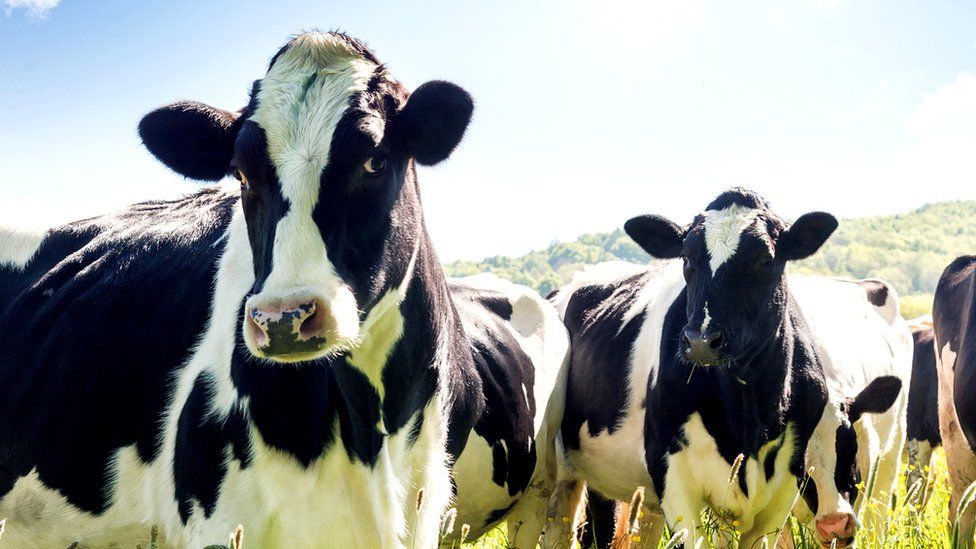
Why cows may be hiding something but AI can spot it

  By Chris Baraniuk Technology of Business reporter Published 22 hours ago Share IMAGE SOURCE, GETTY IMAGES Image caption, Herd animals like...