One Stop shop for Daily Digest - News, Views and analysis of the political developments of the Horn of Africa. Now you can follow by email alerts situated at the bottom. Please feel free to forward any item of interest - it is your blog too (Make it your Home Page)
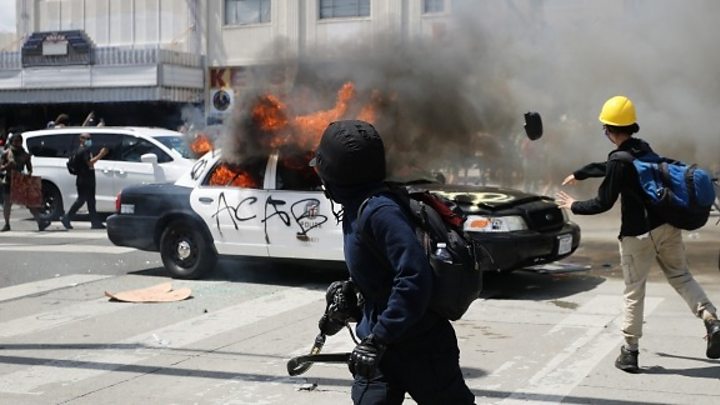
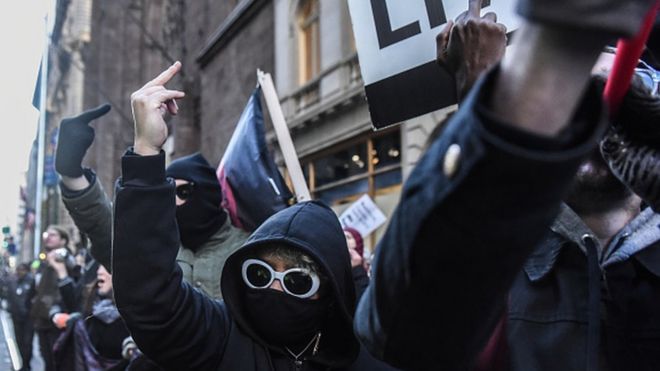
Image copyrightGETTY IMAGESImage captionUS President Donald Trump has repeatedly blamed Antifa for rioting amid George Floyd protests
The US will designate the anti-fascist group Antifa a terrorist organisation, President Donald Trump says.
The president accused Antifa of starting riots that stemmed from protests over George Floyd's death.
Mr Floyd, a black man, died in police custody earlier this week, reigniting anger at police treatment of African-Americans.
Protests over his death have turned violent, prompting major cities to impose curfews.
On Saturday, Minnesota's Democratic Governor Tim Walz suggested that foreign influences, white supremacists and drug cartels were behind the violence, giving few other details.
On Twitter Mr Trump blamed "Antifa-led anarchists" and "Radical Left Anarchists" for the unrest, again without providing more specifics.
Antifa - short for anti-fascist or Anti-Fascist action - is a protest movement that strongly opposes neo-Nazis, fascism, white supremacists and racism.
Most members oppose all forms of racism and sexism, and strongly oppose what they see as the nationalist, anti-immigration and anti-Muslim policies that Mr Trump has enacted.
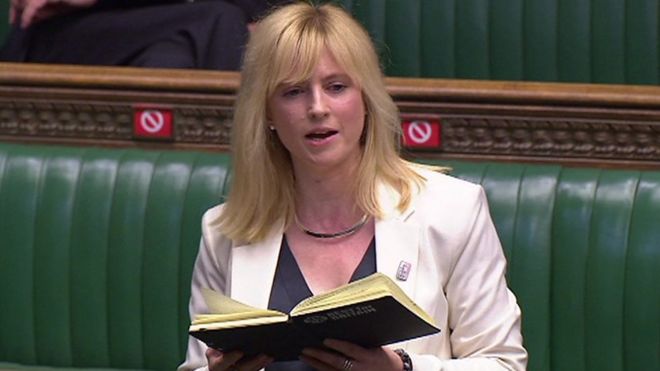
A Labour MP has apologised and stood down from her frontbench role after admitting breaching lockdown rules.
Rosie Duffield met her partner in her Canterbury constituency for a five-hour walk when he was still living with his wife, the Mail on Sunday reported.
Guidance in place at the time in April banned people socialising with anyone from outside their own household.
The MP said she took responsibility for her actions and would quit her role as an opposition whip in the Commons.
The Mail on Sunday said Ms Duffield and her TV director boyfriend James Routh had gone on the walk at a time when they were not living together and strict controls on people's movements were in force to prevent the spread of the virus between households.
The newspaper said Mr Routh had also visited the MP at a property she was renting in Canterbury.
'Difficult situation'
While insisting the pair had observed the two-metre social distancing rule when they met, the MP said she accepted her actions constituted a breach of the guidance at the time.
"My partner and I have been attempting to navigate a difficult personal situation as responsibly as possible," she said.
"I apologise that during that process, we breached the guidelines. A relationship breakdown is difficult at the best of times, let alone during a pandemic.
"I hope people can understand why I took the steps I did and know that I take responsibility for the breaches that occurred and for which I apologise."
The newspaper said Mr Routh, who is understood to have worked on Ms Duffield's 2017 election campaign, had since separated from his wife and was now living in the MP's London flat.
It said Ms Duffield had checked before Mr Routh moved in with her to make sure the new living arrangements complied with the guidance, which she said made provision for the breakdown of marriages.
Ms Duffield had been an opposition whip since the beginning of April, a role in which she was responsible for organising Labour MPs during votes in the House of Commons.
She became the first Labour MP for Canterbury in nearly 100 years when she won the seat in 2017. She retained it with an increased majority last year.
Shadow Chancellor Anneliese Dodds said Ms Duffield had rightly taken responsibility for her actions and relinquished her role as an opposition whip.
"She was absolutely right to resign," she told the BBC's Andrew Marr show. "Clearly she wasn't right to have broken the rules, quite the opposite."
Citing the sacrifices that her constituents had made during the pandemic, Ms Dodds said it was "critically important... that everyone has got to stick to the rules to keep us all safe."
Top members of the US administration have warned that Hong Kong no longer merits a special status when it comes trade, and the territory could be treated the same way as mainland China.
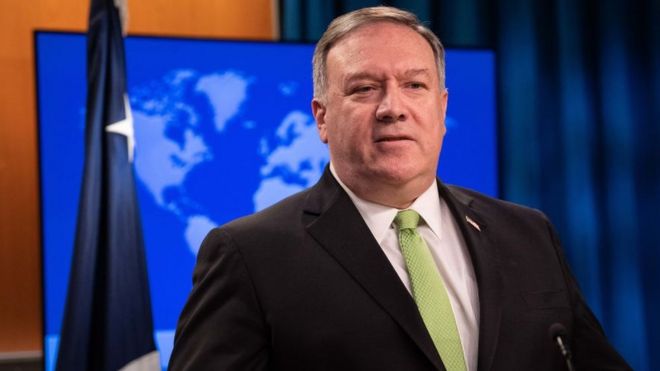
Until now, the US has given Hong Kong favourable trading terms, dating back to the territory's time as a British colony, but US Secretary of State Mike Pompeo told Congress that Hong Kong no longer enjoys a high degree of autonomy from China.
Meanwhile, President Donald Trump's top economic adviser Larry Kudlow said Beijing "will be held accountable" for a new security law set to be imposed on Hong Kong.
The National Economic Council Director told CNBC, "If need be, Hong Kong now may have to be treated the same way as China is treated, and that has implications for tariffs".
So what will it mean if that special status is revoked?
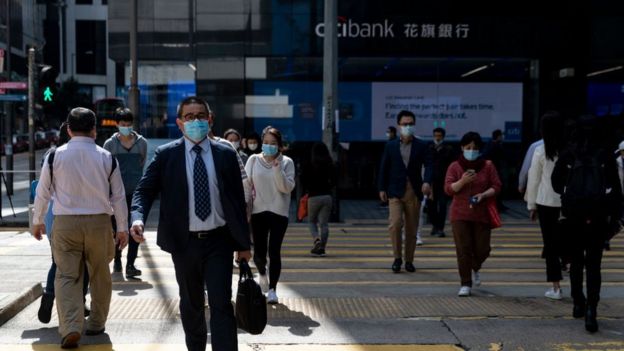
Hong Kong is well-known as one of the world's most important financial centres. With a free economy and a competitive tax regime, it's attracted many multinational companies to its shores.
It's also an important hub for trade. But all of that could be in jeopardy, if the US changes the way it deals with Hong Kong.
So what is the US threatening?
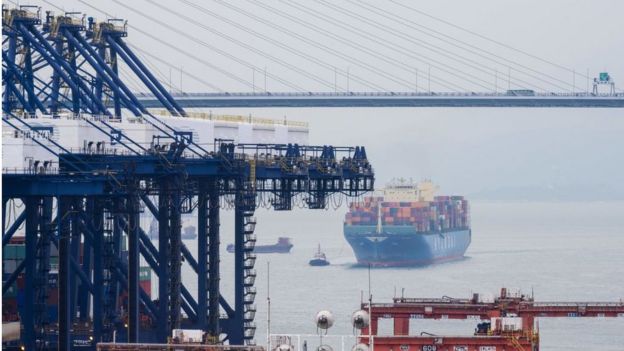
At the moment, Hong Kong enjoys special trade relations with the US. It operates as a separate customs territory to mainland China. It also has a free port, meaning no tariffs are charged on the import or export of goods.
Those arrangements have helped Hong Kong become a centre for global trade. But now the US is threatening to treat Hong Kong the same as mainland China. That would mean its goods would be subject to additional tariffs, including those extra charges that were introduced as part of the US-China trade war, although some of those have recently been rolled back.
Image copyrightGETTY IMAGES
"Hong Kong has had a special trading relationship with different types of tariffs and regulations that have allowed it to trade in a freer way, particularly in relation to capital markets," said Dr Rebecca Harding, independent trade expert and CEO of Coriolis Technologies.
"The US has treated it as an ally, if you like. But it's now saying we are going to treat you in a similar way to how we treat China," she said.
Where does that leave Hong Kong?
Hong Kong is one of the world's top trading territories. In 2018 it was ranked with the 7th highest volume of trade with a total value of nearly $1.2tn.
But much of that trade is made up of goods that pass into, or come out of, mainland China.
In 2018, 8% of mainland China's exports to the US and 6% of mainland China's imports from the US, passed through Hong Kong.
This role as a gateway between the Chinese market and the rest of the world has put Hong Kong in a unique position, but different trade arrangements could change that.
Image copyrightGETTY IMAGES
"If there's a new trade regime in place, that changes the calculation for companies," said Dr Tim Summers, a Senior Fellow at Chatham House, based in Hong Kong.
Companies could choose to move their goods directly through ports in mainland China instead, and higher tariffs there will mean higher price tags.
"The people who are going to get hurt are businesses and consumers," Dr Summers said.
Will China be worried?
Not so much as it might have been at the time of the Hong Kong handover. Back in 1997, Hong Kong played a much more significant role in China's economy, accounting for around 18% of China's GDP.
"But over the last 25 years China has grown massively," said Dr Summers. Hong Kong now contributes just 2-3% of China's GDP.
"Put that in context of the ocean of trade coming out of China, it's not so significant any more. So if President Trump were to act on trade, Hong Kong would suffer, but it's not a gamechanger for China," he said.
Image copyrightGETTY IMAGES
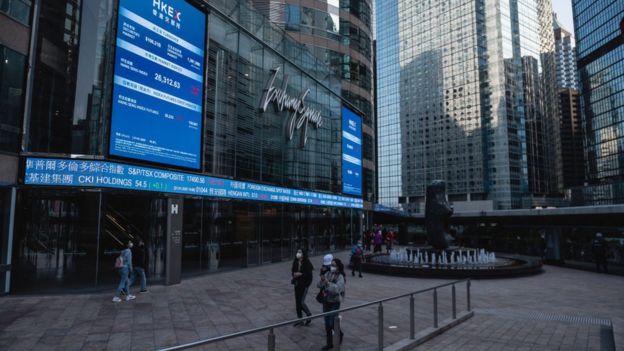
Beijing will however want to maintain Hong Kong's status as a global financial centre. Mainland Chinese companies are among those which choose to list on Hong Kong's Stock Exchange because of its access to global capital. Mainland Chinese companies also benefit from Hong Kong's large financial services sector.
"Shanghai and Shenzhen already have a vibrant financial services sector serving mainlanders," said David Webb, a former investment banker who's lived in Hong Kong since 1991. But so long as Beijing has capital controls on the movement of money in and out of China for investment, "then it can't compete with Hong Kong on international capital," he said.
How could this affect the US?
Each year, billions of dollars worth of goods and services are traded between Hong Kong and the US. In 2018, the total value of that trade was almost $67bn according to the US Trade Representative, including $17bn worth of imports that Americans bought from Hong Kong.
If Hong Kong faces the same trading terms as mainland China, US consumers will pay more for those goods.
"American businesses both in the US itself and in Hong Kong are lobbying hard to try and get any action diluted," said Rachel Cartland, director of Cartland Consulting and a former Hong Kong civil servant.
The US Chamber of Commerce has warned that far-reaching changes to Hong Kong's status would have "serious implications" for Hong Kong and US businesses.
That puts Washington in a tricky position, according Dr Summers.
He says ostensibly, Secretary Pompeo's threat appears to be about recent developments in Hong Kong, and Beijing's new security law for the territory. But he said, what it's really about is US-China relations.
"If I were going to be really cynical, I would say this has provided an opportunity for some people in Washington to take measures they wanted to take anyway against China, in the context of a wider US-China rivalry," he said.
"That may well drive the thinking of what Trump does next more than any particular concern about the political autonomy of Hong Kong," he said.
 GETTY IMAGES