Friday, 12 October 2012

The Soong sisters: Women of influence in 20th Century China


Shanghai Bund
There will be no women at the helm of China's Communist Party when the leadership is reshuffled next month, but there are many more opportunities for women in today's China than there were 100 years ago. Then the only way to achieve influence was to marry it - and three sisters from one family showed how.
On one bank of the Huangpu river in Shanghai stands a forest of steel and glass skyscrapers, but on the other - colonial splendour.
A century ago, foreigners unpacked a whole new fascinating way of life on the docks here.
From Western ships came bicycles, engine parts and young Chinese with a vision of modernity - adventurers like Charlie Soong who had been out to see the world and had come back with ideas about revolution and the role of women.
A Bible publisher and pillar of Shanghai society, Charlie had sons, and in any earlier generation he'd have ignored his daughters.
Soong SistersQingling, Ailing and Meiling, as young women
But he had been educated by American Methodists and he believed in Christian virtue, democracy and the dignity of women.
From this waterfront, he sent his daughters to America to get a grounding in all three.
"It was the hope of the father that these women would come back from the West with the knowledge that they can change China, and change the fate of the people, of the women, and eventually of themselves," says Mabel Cheung, director of a film about the Soong sisters.
As Shanghai boomed, their horizons expanded. And in 1914 the eldest, Ailing, made a strategic match with a young man, H H Kung, who traced his ancestry back to Confucius.
One scene in Mabel Cheung's film shows Shanghai's finest in Western dress, listening to Western music, while the groom tells wedding guests there will be no Chinese-style squat toilets in the marital home, only the best sit-down contraptions imported from America.
Money was no object. He and his bride would become China's richest couple.

“Start Quote

They were constantly on show in a way the imperial family, in days gone by, had never been”
Verity Wilson
Once Kung became finance minister, Ailing discovered a useful way of making her investments grow, explains Jonathan Fenby, who has written a history of modern China.
"He would sit at home and conduct various negotiations about revaluing the currency, or doing this that or other. And she would be taking notes, and get on the phone to her broker afterwards and place large investments," he says.
Qingling, the second sister, married a very different kind of politician - Sun Yatsen, the revolutionary leader of China, who had become President of China after the overthrow of the Qing dynasty in 1912.
As Sun was an older man and already married, Qingling's parents objected - so she jumped out of a window and eloped with him.
Like many other young Chinese people at the time she believed passionately in the idea of a new China, a country freed from feudalism, poverty and imperial dynasties. A country with an equal role for women.
Qingling became Sun Yatsen's constant companion as he struggled to make peace between republicans and warlords.

As History is My Witness

Great Wall of China
  • Former BBC Beijing correspondent Carrie Gracie presents a 10-part series on figures from Chinese history who reveal something about China today
  • Programmes can be heard every weekday on BBC Radio 4 at 13:45 BST
  • Alternatively, listen again on the BBC iPlayer
The youngest sister, Meiling, did not immediately marry.
But all three sisters were very much in the public eye, and in the news magazines almost as often as film stars, says Verity Wilson, who has written several books on Chinese clothing and culture.
"They were constantly on show in a way that the imperial family in days gone by, had never been," she says.
But life wasn't just a round of photo opportunities and jazz. Qingling's husband Sun Yatsen died in 1925 and his movement split into warring camps.
His successor, Chiang Kaishek, was a no-nonsense military man, some would say a fascist.
Qingling was horrified by his tactics. And doubly horrified when she discovered her younger sister Meiling was planning to marry him.
In Mabel Cheung's film, she complains to her elder sister Ailing that Chiang Kaishek is just trying to use the Soong family name to boost his career.
"So what?" retorts the hard-nosed Ailing. "Everyone will benefit. With Chiang's political power, my husband's money and Soong family prestige, we'd become the most powerful group in China."
Meiling SoongMeiling Soong: "Pure sex appeal", according to journalist Edward Murrow
But ideology drove a wedge between the sisters.
In 1927, Meiling married Chiang Kaishek, who soon afterwards launched a bloody purge of communists in Shanghai.
Qingling left for the Soviet Union, and the following year Meiling became the first lady of China.
"Qingling was making a lot of demonstrations and making a lot of noises, which really irritated Chiang Kaishek," says Mabel Cheung.
"It was rumoured that he really wanted to assassinate Qingling, and it was really only Soong Meiling who tried to hold him back."
In 1937, when Japan launched a full-scale invasion of China, Chiang's nationalists and the communists were briefly reunited against the common enemy.
The sisters ran field hospitals and literacy projects together.
Meiling was something of an ambassador for her country, becoming the first private citizen of any country to address the House of Representatives in Washington.

“Start Quote

As I was growing up, Meiling was seen as a bad character - they always referred to those beautiful dresses”
Xun ZhouHistorian
But her command of English and familiarity with America were not her only weapons.
"Many foreign journalists visiting her found her the kind of embodiment of the mysterious, beautiful Chinese woman," says Fenby.
"There was one visiting American journalist, Edward Murrow, who simply wrote in his book, 'She is pure sex appeal.'
"And there's a wonderful bit in the diaries of Alan Brooke, the British Chief of Staff, who depicts her sitting there with a slit skirt, slit to the hip almost, jewelled high-heeled shoes and dark glasses. And Alan Brooke said, I may not quote it exactly: 'From time to time she crossed her legs, and I heard a suppressed neigh, like a horse, from our younger officers.'"
As soon as the Japanese had surrendered in 1945, the nationalists and communists turned on each other again - and this time it was a fight to the finish.
Meiling fled with the nationalists to Taiwan and for the next two decades did her bit to ensure that the US sided firmly with the island against the mainland.
Gu Kailai and Bo XilaiThe murder case involving Gu Kailai fits with the idea of women as a threat
Ailing went to America and Qingling stood by the revolution, showered with honours for the rest of her life by a grateful communist state.
In the Soongs' day women could only exert influence through their husbands.
Now China has women running multinationals and going into space but top-tier politics remains off-limits. There are no women on the standing committee of the Communist Party politburo.
This may be partly because, in tales from Chinese history, women are often depicted as a danger, a threat, says Xun Zhou, a historian at Hong Kong university, who detects a tendency to blame wives for the bad luck or bad judgment of their husbands.
Take Mao and his wife Jiang Qing. It's often said that Mao's only mistake was to listen to Jiang Qing in old age.
"But in fact Jiang Qing was just Mao's tool," says Xun. "Mao was really behind all of it but this is how in China they see women."
And then there is the case of Gu Kailai, wife of the disgraced Chongqing party boss, Bo Xilai, points out John Fenby.

Also in the series...

Sima Qian, Kublai Khan and the Duke of Zhou
"The whole story of the poisoning of the British businessman in the hotel… it's a 'dragon lady' or Lady Macbeth scenario."
Traditionally these scenarios involve dynastic rivalries at court between different concubines and their offspring. Neither Qingling or Meiling had children so could never be accused of playing that game.
Meiling nonetheless became a convenient hate figure for China's leftists. Until the reform era in the 1980s, all good communists were taught that she was a wicked bourgeois.
"As I was growing up, she was seen as a bad character," says Xun Zhou.
"They always referred to those beautiful dresses - she used make-up and wore necklaces, all those things, as bourgeois elements do. And also she was on the nationalist side, which was the enemy."
Qingling's dresses on display in Shanghai in 2008Qingling also wore fine clothes
Chairman Mao died in 1976 and the idea of socialism with Chinese characteristics was dreamed up to bridge the divide between capitalism and communism. Make-up and necklaces didn't seem so wicked after all, and Meiling was rehabilitated.
"In the past 10 or 15 years, she's more represented as this modern, beautiful, intelligent woman. In fact, there's probably more talk about her than her sister Qingling now."
In a cemetery in Shanghai there are tall cedars and flowers in gold and red, the colours of the Chinese flag. Qingling is buried here and there's a dazzling white statue of her.
Her sisters are buried in America. Ailing died in 1973 and Meiling led a quiet life in a Manhattan apartment dying at the grand old age of 105, in 2003.
After 1949, the three sisters were never together again, estranged by history. But all three have taken their thoughts on that separation to the grave.

Abu Qatada appeal: UK asked Jordan to grant pardon


Abu QatadaThe Home Office says Abu Qatada continues to pose a risk to national security

Related Stories

The British government asked the Jordanian authorities to consider a pardon for radical cleric Abu Qatada, it has emerged in court.
But an appeal hearing was told that Jordan said that would not be possible and he would have to stand trial there.
Government sources later said the request related to previous convictions in absentia, not to a fresh trial.
Abu Qatada is challenging Home Secretary Theresa May's decision to order his deportation to Jordan.
Jordan also refused a UK request to ensure evidence from torture was not used against him, a judge heard.
Abu Qatada's appeal to the Special Immigration Appeals Commission is likely to be the last in his seven-year legal battle and is expected to last eight days.
The UK says he is a threat to security but his lawyers question Jordanian assurances over whether he would face a fair trial absent of evidence gained through torture.
Anthony Layden, a former British ambassador to Libya who specialises in negotiating diplomatic assurances, gave evidence at the hearing and revealed details of the talks, which were held in Jordan.
Under cross-examination by Edward Fitzgerald QC, for Abu Qatada, Mr Layden agreed that the possibility of a pardon was explored by James Brokenshire, the then security minister.
During this appeal, the preacher's lawyers are trying to dismantle the government's position that Abu Qatada will get a fair retrial in Jordan.
They want to convince the appeal panel that there was a mad scramble in the Home Office as ministers, officials and special advisors felt the political pressure to get the cleric out.
A pardon for a man whom judges have dubbed "truly dangerous" may surprise many. But, seen through legal eyes, it might have led to deportation - because the European Court's concern is whether Abu Qatada will get a fair trial.
Whitehall sources insist the pardon proposal only related to the preacher's existing convictions in absentia - and not to a possible retrial. They argue that a retrial would be fair.
And that's the single issue in this appeal: has the government got anything to show that he will get a fair trial? Abu Qatada's lawyers say not. It will be for the appeal panel to decide.
The pardon was being sought because the evidence against the cleric was "granted by torture", he agreed.
Mr Fitzgerald asked: "The British government was content for him to have a pardon on the basis that the evidence against him had been obtained by torture?"
"I don't think that I would put it quite like that," said Mr Layden.
"You were asking whether there could be a pardon before he goes back?" said Mr Fitzgerald.
"Yes. Or that he would get a pardon after he goes back."
But Whitehall sources later clarified: "The government has always wanted Abu Qatada to face justice.
"The reference to a pardon was in relation to his in absentia conviction, so he could face a new trial in line with the judgment of the European court."
Abu Qatada has been convicted in absentia of involvement in a plot to cause explosions on Western and Israeli targets in Jordan, to coincide with the millennium celebrations.
However, if returned to Jordan he would be retried for the same offences.
Mr Layden said the UK government had asked Jordanian prosecutors if they would give "an undertaking in advance that they would not rely on the statements" gained through torture, but the Jordanians refused.
"The difficulty was that we could not get an assurance from Jordan [on torture evidence]," said Mr Layden. He said the government had sought some kind of "formula to remove the risk" - but there had been concerns from ministerial special advisors that the talks had not achieved their "minimum requirements".
The former ambassador said there was no risk of Abu Qatada being retried and acquitted, and subsequently held in custody anyway under administrative detention.
Mr Layden said the memorandum of understanding between the UK and Jordan would also help to safeguard against this.
The former ambassador said the radical cleric "will get a trial which is sufficiently fair to discharge our responsibilities" in protecting his human rights.

“Start Quote

If that's the only evidence in the case... it's difficult to understand on what basis the appellant [Abu Qatada] could be prosecuted”
Mr Justice Mitting
Presiding judge Mr Justice Mitting has already said the Jordanian terror suspect's links to an alleged bomb plot looked to be "extremely thin".
He stated that the "only evidence" of a link was that Abu Qatada had paid $5,000 (£3,100) for a computer.
Reviewing legal documents, Mr Justice Mitting said they suggested that an alleged co-conspirator - who has claimed he was tortured before giving evidence - had been given the money by Abu Qatada.
"If that's the only evidence in the case... it's difficult to understand on what basis the appellant [Abu Qatada] could be prosecuted," the judge said.
The Special Immigration Appeals Commission is a semi-secret court that deals with national security deportations where some of the sensitive material cannot be disclosed in public.
Danny Friedman, representing Abu Qatada, agreed and said there were "very serious problems" with the case.
He added that witnesses did not give statements voluntarily and were "threatened with torture" while in detention in Jordan.
But a document submitted to the court by lawyers for Home Secretary Teresa May claims Abu Qatada had "failed to demonstrate" that his removal to Jordan would amount to a "flagrant denial of justice".
Repeated failed attempts by UK governments over the last 10 years to deport the radical cleric, who is in custody and did not attend Thursday's hearing, have cost nearly £1m in legal fees, according to government figures.

Lance Armstrong: Tyler Hamilton on 'how US Postal cheated'


CLICKABLE
Eleven of Lance Armstrong's former team-mates have told their stories of doping with the US Postal Service cycling team, but none in such detail as Tyler Hamilton.
His book, The Secret Race, published in September, provides minute detail on how the drugs were obtained, how they were stored, delivered to the riders and injected, and how the syringes were carried away in a Coke can.
Most astonishingly, he explains how easy it was to beat the testers.
Lance Armstrong has rejected Hamilton's allegations, while his lawyer described the latest condemnation from the US Anti-Doping Agency (Usada) as a "one-sided hatchet job".
Hamilton started off on testosterone, a "red egg" as the cyclists referred to the pill, but soon graduated on to the more powerful EPO - erythropoietin - which he and his US Postal Service team-mates dubbed Edgar, after Edgar Allen Poe.

Hamilton on Armstrong

Armstrong leads Hamilton, in yellow, on the Criterium du Dauphine, June 2000
  • EPO - "I saw him multiple times take an EPO, that wasn't a big deal really because we all did it"
  • Cortisone - "I know he took cortisone, I never saw him take it but I know he took it"
  • Actovegin - "I saw him get Actovegin, you get that injected on the morning of a race"
  • Testosterone - "I saw him take testosterone, both in pill and liquid form"
  • Blood doping - "We did transfusion together in the year 2000"
This stimulates the creation of red blood cells, boosting performance by about 5%, or, as Hamilton puts it "roughly the difference between first place in the Tour de France and the middle of the pack".
EPO can be detected in the body for a number of hours after it has been taken - the "glowtime". During this time, the cyclist needs to avoid a meeting with the dope tester.
So, during the months of training, they kept track of when they had taken the drug, and tipped each other off by phone whenever a tester appeared in Girona, the town in northern Spain where the cyclists were based. In The Secret Race, co-authored by journalist Daniel Coyle, Hamilton lists three tips:
"Tip one: Wear a watch. Tip Two: Keep your cellphone handy. Tip three: Know your glowtime, how long you'll test positive after you take the substance. What you'll notice is that none of these things is particularly difficult to do."
They were more like "discipline tests, IQ tests" than drug tests, he says.
"If you were careful and paid attention, you could dope and be 99% certain that you would not get caught."

“Start Quote

Lance pointed casually to the fridge - I opened it and there, on the door, next to a carton of milk, was a carton of EPO”
Tyler HamiltonThe Secret Race
On one occasion Hamilton heard a knock on the door when he was glowing, and simply hid inside the house in silence until the tester gave up and went away.
They never came during the night, making late evening the best time for doping. One elderly tester even called in advance to let the cyclists know when he was coming.
"The most conventional way that the US Postal riders beat what little out-of-competition testing there was, was simply to use their wits to avoid the testers," says the Usada report published on Wednesday.
It adds that Armstrong sometimes stayed at an out-of-the-way hotel where he was "virtually certain not to be tested".
Armstrong is described in the report as the enforcer of US Postal's "massive and pervasive" doping programme.
"It was not enough that his team-mates give maximum effort on the bike," Usada says. "He also required that they adhere to the doping programme outlined for them or be replaced."
But it wasn't only US Postal that was doping, of course. More than half the Tour de France winners since 1980 have either tested positive, been sanctioned for doping, or admitted it.
Tour de France winners since 1980
Talking to BBC Radio 5 Live, Hamilton said this week that it was "a dark period of cycling that we all went through".
"None of us when we were 15 or 16 years old were planning on doing that, but we all kind of rode our way up the ranks and came into this world. It was a world that already existed, when we got there. The doctors, the riders had been doing these things for years."

“Start Quote

I have always said that I have zero tolerance for anyone convicted of using or facilitating the use of performance-enhancing drugs”
Lance Armstrong
George Hincapie, US Postal team captain from 1999-2005, admitted doping for the first time on Wednesday, saying that early in his professional career it became clear to him "that given the widespread use of performance-enhancing drugs by cyclists at the top of the profession, it was not possible to compete at the highest level without them".
Hamilton writes in The Secret Race that he visited Armstrong at his home in Nice some time before the 1999 Tour de France, and finding himself without EPO, asked if he could use some of Armstrong's.
"Lance pointed casually to the fridge. I opened it and there, on the door, next to a carton of milk, was a carton of EPO, each stoppered vial standing upright, little soldiers in their cardboard cells."
In 1998, the team had distributed the EPO in white lunch bags. But this was the year the Festina and TVM teams were caught with large quantities of steroids, EPO and syringes. So in 1999 greater care was needed. According to Hamilton, Armstrong arranged for his gardener to follow the Tour on a motorbike, carrying a thermos flask full of EPO tubes.
"When we needed 'Edgar', Philippe would zip through the Tour's traffic and make a drop-off," he writes in The Secret Race.

Tyler Hamilton

  • Key team-mate of Lance Armstrong in the 1999-2001 Tours de France, all won by Armstrong
  • Completed the 2002 Giro d'Italia with a fractured shoulder, finishing second
  • Completed 2003 Tour de France with broken collar bone, won stage 16 in solo breakaway
  • Suspended twice in 2004 and 2007 for testing positive, retired in 2009 after another failed test
By the following year, they had begun blood doping, flying to Spain to have their blood drawn by the team doctor, Hamilton says.
This blood, rich in red blood cells, was then delivered back to the tired riders, to help boost their red blood cell count during the race.
Riders found blood bags, still cold from the refrigerator, taped to the wall next to their beds in their hotel rooms. Hamilton describes the sensation of goosebumps as the chilled blood circulated around his body.
One

Order to arrest India Kingfisher chief Vijay Mallya


Vijay MallyaLegal experts say Vijay Mallya is unlikely to be arrested soon

Related Stories

A court in the southern Indian city of Hyderabad has issued an arrest warrant for Vijay Mallya, owner of the cash-strapped Kingfisher Airlines.
The warrant relates to a case brought by Hyderabad International Airport after cheques, worth 103m rupees ($1.9m; £1.2m), bounced.
Kingfisher has struggled to repay its debts. The money owed in this case was reportedly to cover airport charges.
Legal experts say it is unlikely that Mr Mallya will be arrested imminently.
They say Mr Mallya will probably be summoned to court at an agreed future date and is likely to get bail.
This arrest warrant was only issued when Mr Mallya failed to appear in court, despite a summons issued to him after the cheques bounced.
Mr Mallya, the crisis-hit airline's flamboyant owner, is also an MP in the Rajya Sabha, the upper house of the Indian parliament, as well as the chairman of the United Breweries group, India's largest brewing company, which makes Kingfisher beer.
Meanwhile, Kingfisher Airlines has extended its shutdown until 20 October after failing to persuade its striking staff to return to work.
The airline grounded its fleet on 1 October after some workers went on strike protesting against months of unpaid wages.
Kingfisher has been struggling with a cash shortage and has reported losses for five years in a row.
In July, the airline was forced to cancel 40 flights after staff went on strike, again over the airline's failure to pay months of wages.
After the government relaxed investment rules last month allowing foreign airlines to buy up to a 49% stake in domestic carriers in India, Mr Mallya said discussions were taking place which could allow overseas operators to invest in the airline.
But analysts say that the current disruption and safety concerns could hurt efforts to win the investment that could save the airline from collapse.

Syria plane carried radar parts, not weapons - Russia


Syrian Air plane at Ankara airport, Turkey (10 Oct 2012)A diplomatic row has developed over what the Syrian Air civilian plane was carrying from Moscow
Russia says the Syria-bound plane intercepted by Turkey amid reports it was carrying cargo which could aid government war efforts was transporting a legal shipment of radar equipment.
"There were no weapons on the plane," said Foreign Minister Sergei Lavrov.
His comments followed heated exchanges between Turkey and Syria over the exact nature of the items confiscated.
Turkey's PM earlier said Russian-made defence equipment was found on board - a claim Syria dismissed as a lie.
Damascus has challenged the Turks to put the seized goods on public view.
Relations deteriorated sharply last week after the deaths of five Turkish civilians in shelling from across the border.
On Friday, Turkey reportedly scrambled fighter jets after an air attack on a Syrian frontier town by Syrian government forces.
And in Syria itself, activists said rebel fighters had seized a government air defence base near the embattled north-western city of Aleppo.
'Dual-purpose cargo'
The Syrian Air plane was intercepted by Turkish fighter jets en route from Moscow to Damascus on Wednesday, and forced to land in Ankara.
"We have no secrets," the Russian foreign minister told reporters in Moscow in the government's first official comments on the cargo aboard the Syrian Airbus 320.
"There were, of course, no weapons on the plane and could not have been any.
"This cargo is electrical technical equipment for radar stations, this is dual-purpose equipment but is not forbidden by any international conventions," Sergei Lavrov said.
His comments were the Russian government's first remarks about the nature of the cargo.
Viktor Murakhovsky, a defence expert, told the BBC Russian Service that the equipment was "definitely for anti-aircraft systems".
"These are usually magnetrons and travelling-wave tubes, which need replacing fairly frequently," he said.
Russia has remained an ally of the Syrian government, whereas Turkey has been a critic of Syrian President Assad since anti-government protests erupted there more than a year ago.
Russia also has arms contracts with the Syrian government worth billions of dollars.

Monday, 1 October 2012

Madaxweynaha Soomaaliya Xasan Sheekh Oo Dib Ugu Soo Laabtay Muqdisho Iyo Kulamo uu Saraakiil Iyo Masuuliyiin uu Kula Soo Qaatay Baydhabo

Muqdisho (RBC Radio) Madaxweynaha dowlada Soomaaliya Xasan Sheekh Maxamuud ayaa dib ugusoo laabtay magaalada Muqdisho ee Caasimadda dalka kadib socdaal uu maanta ku tagay magaalada Baydhabo ee xarunta gobolka Baay.
Magaalada Muqdisho ayaa madaxweynaha waxaa ku soo dhoweeyay xubno ka tirsan baarlamaanka Soomaaliya iyo waliba masuuiyiin kale oo ka tirsan dowlada Soomaaliya, waxaana sidoo kale madaxweynaha la socday masuuliyiin uu hogaaminayay oo la tagay magaalada Baydhabo.
Madaxweyne Xasan Sheekh iyo waliba Wafdigiisa waxay kulan la soo qaateen qaar ka mid ah dadka magaalada Baydhabo saraakiil ka tirsan AMSIOM iyo saraakiisha dowlada Soomaaliya.
Madaxweynaha ayaa intii uu ku sugnaa magaalada Baydhabo waxa uu khudbad u jeediyey kumanaan shacabka reer Baydhabo ah oo uu kula hadlay goob fagaare ah waxaana uu ku ammaanay shacabka gobolka Baay sida ay Ciidammada ammaanka kala shaqeeyeen Nabadda.
Xasan Sheekh wuxuu kula dar daarmay dadka magaalada Baydhabo in ay la shaqeeyaan ciidamada dowlada Soomaaliya iyo kuwa AMISOM ee ku sugan magaaladaasi si amaanka looga wada shaqeeyo.
Safarkan uu maanta magaalada Baydhabo ee xarunta gobolka Baay ku tagay Madaxweynaha  Federaalka Soomaaliya  Xasan Sheekh Maxamuud ayaa waxa uu noqonayaa safarkii ugu horeeyey oo uu kaga ambabaxo magaalada Muqdisho tan iyo intii loo doortay xilka Madaxweynaha Jamhuuriyadda.
RBC Radio
Xafiiska Wararka Muqdisho

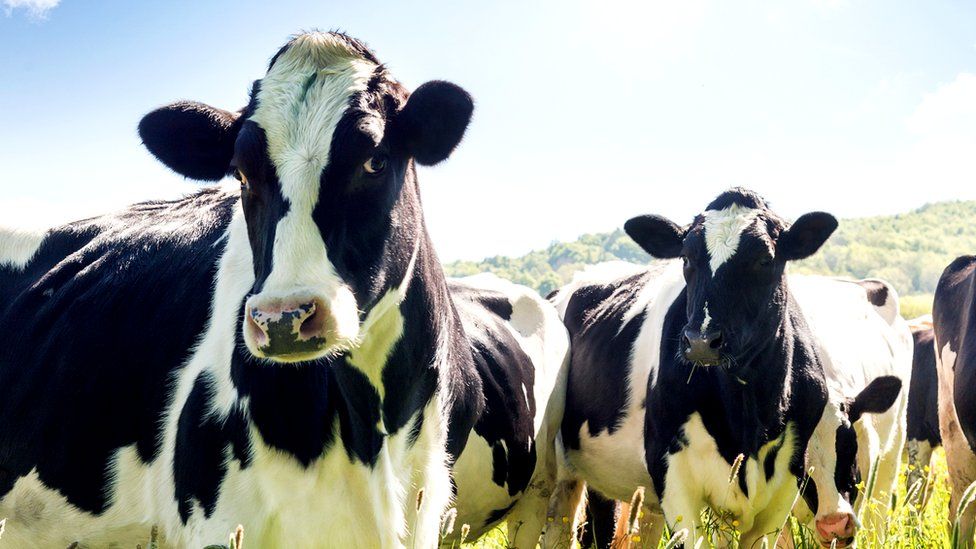
Why cows may be hiding something but AI can spot it

  By Chris Baraniuk Technology of Business reporter Published 22 hours ago Share IMAGE SOURCE, GETTY IMAGES Image caption, Herd animals like...